 STOP PRESS. While you were away the Red Sox finally secured their first American League East title in 12 years. On 29 September 2007, they beat the Twins, 5-2, to reduce their magic number to one, and an hour later the Yankees put it at zero by snatching defeat from certain victory by wasting a three-run lead in the ninth and losing to the Orioles in 10 innings on a bases-loaded, two-out bunt single. As regular readers of this Blog know, after taking first place in the Division on April 18, the Red Sox never let it go and have now won their first division title since 1995. The AL Division Series are now set, with the Angels to play at the Red Sox and the Yankees at Indians. What’s more the Sox finished with the best overall record and secured the right to select the seven-day series starting on Thursday. Dare we believe in a World Series? We'll keep you posted. GO SOX. Oh yes ..Norway…..
 We would do 370 kilometers this Wednesday 20th June 2007, the 14th day of our trip. The Blog is being written up months after we finished and returned home. Just as well B kept notes along the way or many of the details would be forgotten by now. The moral for today (we can get it out of the way quickly and then you can relax) is to ask the price before you purchase. No point in D keeping an eagle eye on all the prices and labels if you do not play your part too. OK, OK, OK , Norway is not in the EU and does not have to comply with pricing regulations. Maybe that is the reason the Fjeldstue does not post its prices for meals. The place is in the middle of nowhere and choice is at a premium (that’s another clue). There is a general assumption that when you booked you will also want dinner and we went along with that, as you know from last week’s Blog. B swallowed hard again when he got the bill and tendered his Visa! In future ask the price! Of course from this distance the meal, which was of great quality, is still remembered but the price forgotten. Now, digest all that and take from it whatever moral you wish!
 On this bright warm day we made our way along Route 29, then Route 27 then the E6, E4 and finally Route 22 to Oslo (well Lillistrom, actually, if you want to be picky). All suggested by John Clarke the night before and we were glad to have taken his advice. It was a fantastic route over mountains and on quiet roads that we had to ourselves and the weather just got warmer and warmer.
 We diverted to Ringebu to visit the Stavkirke (Stave Church). Now, before this trip I had no idea what a Stave church was. B has discovered them in his research, or perhaps he knew of them all along. Either way he was determined that we should see one. These are a type of wooden church built in Norway in the Middle Ages. The literature suggests that it was contrary to Canon Law to raise churches entirely of wood, and that that the Roman Catholic Church demanded the use of stone as the main material. Even if it was established practice to build in stone, there seems to be no documentation showing that such a rule was ever given as an order. An Irish Ordo from before 900 AD shows that wooden churches were given the same ritual as those in stone which seems to suggest that the Irish at least were OK with wood. While the earliest of those constructed in Norway date from the beginning of the 11th century, when Christianity began to spread through Norway, most of the 600 or so churches eventually date from the 12th century.
Ultimately, as congregations grew large, Romanesque buildings replaced these extraordinary wooden churches. They are the only ‘temples in wood’ to survive in the West and foreign influence has been adapted to native form and to local needs, in a country with vast areas of forest and a scattered population. The exterior might remind you of a pagoda, but the pagoda, with its stepped masts and cantilevered roofs, aims at an exterior effect whereas with the stave church, on the other hand, the interior, as a place of worship is of primary importance (That is the sting in this tale!).

 The church at Ringebu, built around 1220, is one of 28 surviving stave churches and is one of the largest. It was converted into a cruciform in approximately 1630 and restored in 1921. Originally the churches were built around posts sunk into holes in the ground but these were vulnerable to rotting and few have survived although evidence of the old post holes have been found beneath the present church. (WHAT?: They built over the traces of the old wooden post holes: now where else is that to happen ???). Reminds me of my Paris to Rome trip when S (Bro) admonished me for enthusing about Roman viaducts while condemning new motorways. From his engineers perspective both were constructions which cut through valleys: time was relative.
The stone foundation of the stave church supports four horizontal wooden beams,  from which rise four corner posts, or staves. The posts are joined together by four upper crossbeams. Thus, the basic boxlike frame of the church is formed. From this framework, timbers extend outward, supporting a series of uprights, or masts. (Indeed, these churches are sometimes called "mast churches.") In this way, open aisles are created on all sides of the nave (For your next Table Quiz, note that brides do not actually walk down the aisle at all!!!) . The sanctuary itself is a small shed projecting from one end of the nave. Outer walls are formed of upright planks (which distinguishes them from log cabin type constructions). There may be four or more ranks of masts, with an equal number of triangular frames rising above them, gradually diminishing in size.
They would not allow photos inside, and to our eternal shame, we did not support them by paying in. We slipped away quietly...or as quietly as motorbike engines allow.
Our next stop was in the home of the 1994 Winter Olympics: Lillehammer. In 1986 the IOC voted to change the schedule of the Olympic games so that the summer and winter Games would be held in different years. To adjust to this new schedule, the Lillehammer Games were held in 1994, the only time that two Games have been staged two years apart. (You can learn so much here!) The 1994 Games were extremely well organised and the Norwegian love of winter sports added to the spirit of the occasion.
 from which rise four corner posts, or staves. The posts are joined together by four upper crossbeams. Thus, the basic boxlike frame of the church is formed. From this framework, timbers extend outward, supporting a series of uprights, or masts. (Indeed, these churches are sometimes called "mast churches.") In this way, open aisles are created on all sides of the nave (For your next Table Quiz, note that brides do not actually walk down the aisle at all!!!) . The sanctuary itself is a small shed projecting from one end of the nave. Outer walls are formed of upright planks (which distinguishes them from log cabin type constructions). There may be four or more ranks of masts, with an equal number of triangular frames rising above them, gradually diminishing in size.
They would not allow photos inside, and to our eternal shame, we did not support them by paying in. We slipped away quietly...or as quietly as motorbike engines allow.
Our next stop was in the home of the 1994 Winter Olympics: Lillehammer. In 1986 the IOC voted to change the schedule of the Olympic games so that the summer and winter Games would be held in different years. To adjust to this new schedule, the Lillehammer Games were held in 1994, the only time that two Games have been staged two years apart. (You can learn so much here!) The 1994 Games were extremely well organised and the Norwegian love of winter sports added to the spirit of the occasion.

Local hero Johann Koss won three speed skating events and set a world record in every one. Vreni Schneider won a complete set of medals in alpine skiing and Manuela Di Centa earned medals in all five cross-country events. Myriam Bedard won both women's individual biathlon races. Gustav Weder and Donat Acklin became the first repeat winners of the two-man bobsled. Pairs skaters Ekaterina Gordeeva and Sergei Grinkov returned to repeat their Olympic victory of 1988. Dan Jansen (USA-speed skating) had experienced nothing but disappointment at the Olympics. His last chance was the 1,000m in Lillehammer. He was on world record pace when he slipped during the penultimate turn. Fortunately, he steadied himself and powered on to set a world record and win a gold medal at last. The composition of the Bosnia and Herzegovina four-man bob team was: one Croatian, two Bosnians and a Serbian - the best possible example of the Olympic spirit at the worst of times. Oh, and while the Games were opening on 12 February in 1994, a gang was stealing Munch's Scream from the National Gallery: don't worry though, it was recovered the following May!
 We found our way to the Lillehammer Olympic Park, which includes Håkons Hall, Lysgårdsbakkene Ski Jumping Arena, Birkebeineren Ski Stadium, Kanthaugen Freestyle Arena and Lillehammer Olympic Bobsleigh and Luge Track. In Håkons Hall there are sports facilities for handball, football, volleyball, badminton, squash, fitness training, indoor climbing and golf along with the Norwegian Olympic Museum. In the Ski Jumping Arena you can, apparently, take the chairlift to the top of the big ski jump. Allegedly you can try most of the sports during the winter and even in the summer you can try a unique bobsleigh on wheels. We saw the museum and were disappointed with it (although as you can gather we did pay attention to notes on the history of the event!!) . I saw the sign for the chairlift but let is pass. We missed everything else.

I knew it then and writing it up confirms it: at this stage in the trip fatigue was starting to set in. We were not paying attention to the finer details any more. Some of the quality of Norway was slipping past me. Physically, the tiredness was manifesting itself for me in a sore shoulder. If you have read Primo Levi (and if not I recommend ‘If This is a Man’) you may recall how in all the horrors of the concentration camp a stone in his shoe was enough to distract his mind from everything else. The humna mind is such that a small pain obscures the bigger picture. In Levi’s case it helped him survive by enabling him to concentrate on that one overriding problem which he knew could be easily solved. The pain in his shoe helped obscure the bigger horror. In my case the niggling shoulder pain distracted me from everything else so that it got to points over the next few days that, no matter what, I just wanted to stop to rest the arm for a few minutes. It annoyed the hell out of me and when we tried to ‘push on’ it only made it and me worse!
We found our way to the Lillehammer Olympic Park, which includes Håkons Hall, Lysgårdsbakkene Ski Jumping Arena, Birkebeineren Ski Stadium, Kanthaugen Freestyle Arena and Lillehammer Olympic Bobsleigh and Luge Track. In Håkons Hall there are sports facilities for handball, football, volleyball, badminton, squash, fitness training, indoor climbing and golf along with the Norwegian Olympic Museum. In the Ski Jumping Arena you can, apparently, take the chairlift to the top of the big ski jump. Allegedly you can try most of the sports during the winter and even in the summer you can try a unique bobsleigh on wheels. We saw the museum and were disappointed with it (although as you can gather we did pay attention to notes on the history of the event!!) . I saw the sign for the chairlift but let is pass. We missed everything else.I knew it then and writing it up confirms it: at this stage in the trip fatigue was starting to set in. We were not paying attention to the finer details any more. Some of the quality of Norway was slipping past me. Physically, the tiredness was manifesting itself for me in a sore shoulder. If you have read Primo Levi (and if not I recommend ‘If This is a Man’) you may recall how in all the horrors of the concentration camp a stone in his shoe was enough to distract his mind from everything else. The humna mind is such that a small pain obscures the bigger picture. In Levi’s case it helped him survive by enabling him to concentrate on that one overriding problem which he knew could be easily solved. The pain in his shoe helped obscure the bigger horror. In my case the niggling shoulder pain distracted me from everything else so that it got to points over the next few days that, no matter what, I just wanted to stop to rest the arm for a few minutes. It annoyed the hell out of me and when we tried to ‘push on’ it only made it and me worse!

 In that way, regrettably, I failed to fully app
 reciate the beauty of the forested mountain landscape that was, once again, a change of Norwegian scenery and one of the few days when we were not ‘by the sea’. I was relieved when we finally arrived in Lillestrom, just outside Oslo, the Norwegian capital.
 Tomorrow was a rest day, and I was glad of that!


 reindeer antlers tacked onto the outside walls, dates back to the eighteenth century. Dinner is served in the excellent, reasonably priced restaurant, and the complex also includes a café and a small park information centre. The inn is a lovely spot to break your journey and an ideal base for hiking into the Dovrefjell National Park, which extends to east and west. If you're arriving by train, note that only some of the Oslo– Trondheim trains stop at Kongsvoll station, 500m down the valley from the inn – and then only by prior arrangement with the conductor.


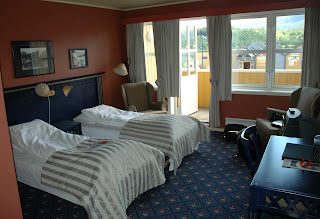


 We had done 288 kilometres that day in sunny dry and cold conditions. How better to end the day than by maintaining standards with a liberal application of polish to the boots while having a pint on the balcony.


 Talking of the bike, I must say thanks to R. He supplied the paint and brushes from his Warhammer kit to enable me paint white lines on the


